

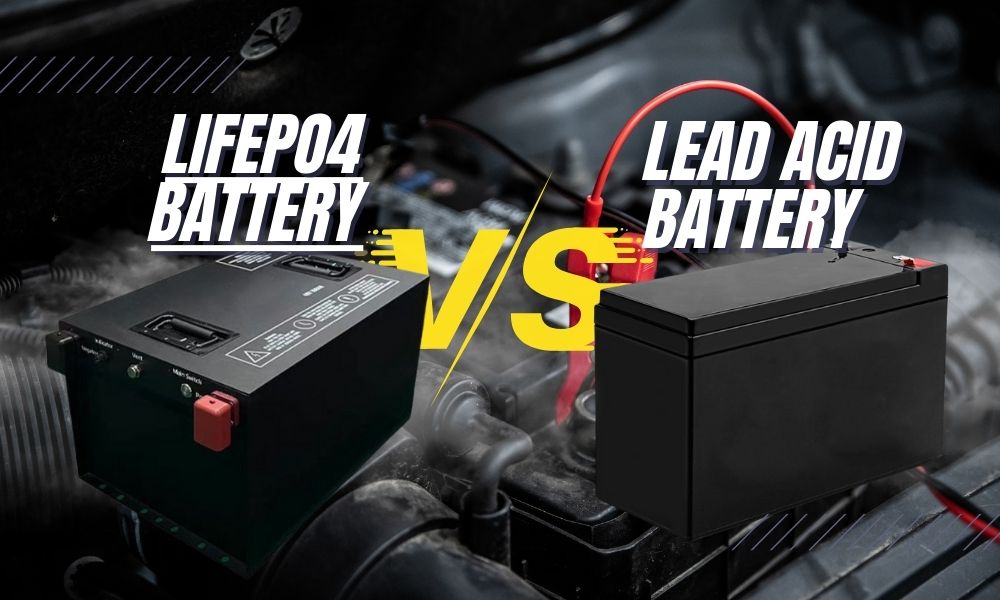
LiFePO4 battery is a new type of rechargeable lithium-ion battery. It has high energy density, is safe and reliable, is green and environmentally friendly, and has a long cycle life. It has become a new choice to replace traditional lead acid batteries.
Why can LiFePO4 battery win in the competition with lead acid battery? Below, I will introduce you in detail from three aspects: the disadvantages of lead acid batteries, why choose LiFePO4 battery, and the comparison between LiFePO4 batteries and lead acid batteries.
Disadvantages of Lead Acid Battery
In the past, lead acid battery was widely used in various devices, but soon people discovered many problems with lead acid batteries, such as bulging and leakage, corrosion, increased internal resistance, and fire safety hazards. In addition, it is large, very heavy, short in life, and has no intelligent monitoring system.
These problems lead to high management, maintenance, and replacement costs of lead acid batteries.
It’s time to find a new type of rechargeable battery to replace it! Next, let’s take a look at why lead acid batteries are being eliminated from four aspects: battery performance, technological development, management and maintenance, and safety!
1.Battery Performance
Lead acid battery has many shortcomings, such as heavy weight, large volume, large footprint, low energy density, lead content that is not environmentally friendly, and short cycle life. If lead acid battery is used for a long time, the electrode materials will be corroded, causing the internal resistance to increase, posing a safety hazard. Their performance is far lower than that of lithium-ion batteries currently on the market, and it is inevitable that they will be eliminated.
2.Technological Development
In recent years, the development of batteries has gone through the process of lead acid batteries, nickel cadmium batteries, and now lithium batteries and sodium-ion batteries. We can see that batteries have been developing in the direction of higher and higher capacity density, and becoming more environmentally friendly and safe. Therefore, it is inevitable that low-performance and environmentally unfriendly lead-acid batteries will be replaced by lithium batteries. This is an unstoppable trend in technological development.
3.Battery Management and Maintenance
The management and maintenance costs of lead acid batteries are very high. Lead acid batteries are in series, which leads to internal resistance consistency problems. If a single battery cell has a problem, the entire battery pack needs to be replaced.
In equipment that uses a large number of lead acid batteries (such as large transportation vehicles and subway battery rooms), lead acid batteries are very troublesome to use and manage in daily life. They need to be cleaned from time to time, and voltage and internal resistance measurements are required. If the battery needs to be replaced, it also consumes a lot of manpower and material resources. Moreover, its service life is short, and it needs to be replaced almost every 3-5 years, which is very inconvenient.
4.Battery Safety
The outer shell of lead acid batteries is mostly made of ABS material, which makes it easy to burn and produce thick smoke when it encounters fire. Its internal corrosion problem also poses a safety risk. In addition, it is very sensitive to temperature and may produce toxic and harmful gases. The use of lead acid batteries requires a good heat dissipation and ventilation environment.
The above problems of lead acid batteries make it urgent to find a new type of battery that can replace it.
Why Choose LiFePO4 Battery?
We have introduced the disadvantages of lead acid batteries above. Now let’s take a look at which battery is the most suitable replacement for lead acid batteries among the various types of batteries.
Lithium-ion batteries are currently the most advanced batteries. They mainly include lithium iron phosphate batteries, ternary lithium batteries, lithium manganese oxide batteries, lithium titanate batteries, lithium cobalt oxide batteries, etc.
Although the energy density of ternary lithium batteries (nickel cobalt manganese oxide, nickel cobalt aluminum oxide) is very high, it still has some shortcomings in terms of safety and cost.
Lithium manganese oxide batteries have low costs, but their raw materials are not stable enough, they are easy to decompose and produce gas, and they have short cycle life, poor high temperature performance, and the battery temperature cannot exceed 80 degrees Celsius.
Lithium titanate batteries are very safe, have a long life, and are suitable for a wide temperature range. However, it has not yet solved the problem of expansion, which affects the performance of the battery in a high temperature environment. Moreover, its energy density is lower than that of other lithium batteries.
Lithium cobalt oxide batteries have high energy density, but poor safety, high cost, and short service life.
The energy density of LiFePO4 battery is lower than that of ternary lithium battery, but its safety performance is very excellent, and it can still maintain a stable structure and performance in a high temperature environment. Even if the battery is damaged or severely deformed, it will not smoke, catch fire, or burn. In addition, its raw materials are very abundant in nature, which greatly reduces the manufacturing cost and use cost of the battery.
Considering the comprehensive battery performance, safety, cost-effectiveness, and environmental protection, there is no doubt that the LiFePO4 battery is the most comprehensive lithium-ion battery! It stands out from the competition and becomes the optimal solution for lead acid battery replacement!
LiFePO4 Battery VS Lead Acid Battery
1. In the same volume, LiFePO4 battery has higher voltage, greater energy density, and lighter weight than lead acid battery.
2.Lead acid battery is greatly affected by temperature and easily produce gas at high temperature. LiFePO4 battery has a wider operating temperature range. At a high temperature of 55 degrees Celsius, it can still release more than 90% of its energy.
3.Lead acid battery contains lead, which is a heavy metal that can cause harm to the environment and human body. LiFePO4 battery materials do not contain any heavy metals with potential risks.
4.The self-discharge rate of lead acid battery is higher than that of LiFePO4 battery.
5.The discharge rate of LiFePO4 battery is higher than that of lead acid battery.
6.The internal resistance of LiFePO4 battery is lower than that of lead acid battery.
7.The actual service life of lead acid battery is about 5 years, and its capacity attenuation problem is also serious, with a cycle number of 500-600 times. The service life of LiFePO4 battery is 10-15 years, and the number of cycles is generally more than 2000 times.
8.LiFePO4 battery has a complete battery management system (BMS), with higher sensor accuracy, more convenient management and maintenance than lead acid batteries, and lower cost.
9.LiFePO4 battery is a series-parallel structure, which makes its assembly method very flexible, and new batteries and old batteries can be mixed. But lead acid batteries can only be connected in series.
Summarize
Through the above introduction, we already know why LiFePO4 battery can become the best alternative to lead acid battery. From the current point of view, LiFePO4 battery has actually been widely used!
I believe that in the future, rechargeable batteries will develop towards higher energy density, more environmentally friendly, safer, higher endurance, and faster charging efficiency. Lead acid batteries will be gradually eliminated and become history.
About the Author
Liteway is a professional manufacturer and supplier of alkaline batteries, carbon-zinc batteries, and lithium batteries based in Ningbo, China.
We have more than 20 years of manufacturing and exporting experience in the battery field, providing battery manufacturing and OEM/ODM services to customers all over the world. We are a co-manufacturer for many battery brands and have been unanimously recognized by our partners during the cooperation process.
Lithium-ion batteries are one of our battery series. If you want to learn about our lithium-ion batteries, please click here.
If you want to cooperate with us and let us manufacture and customize batteries for you, please contact us.