

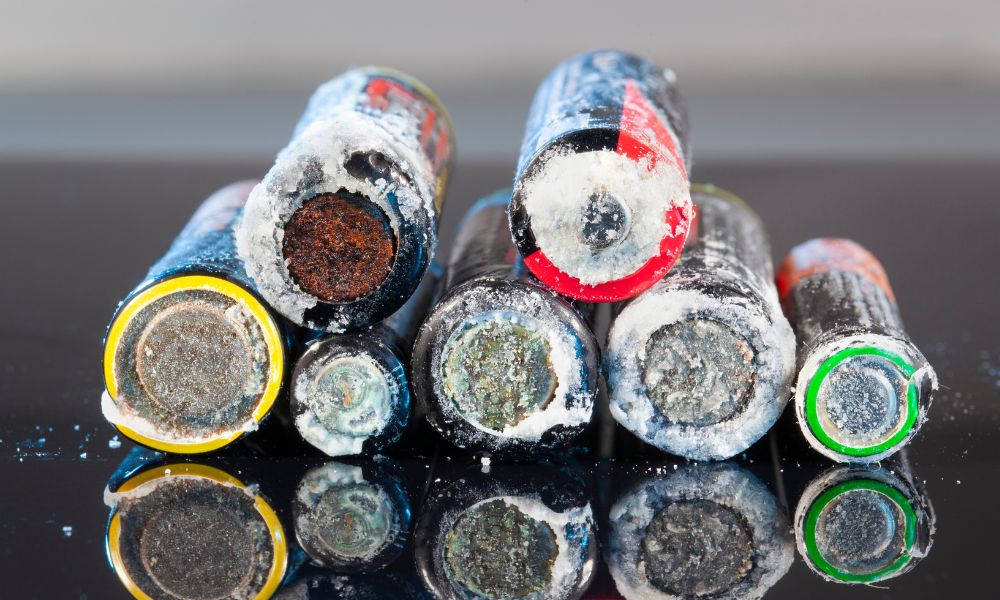
Alkaline zinc manganese battery is a very common battery type. With the improvement of its production process, materials, and structure, its battery capacity, power, and discharge performance have been significantly improved. But on the other hand, the battery leakage problem has never been completely solved.
The problem of alkaline battery leakage will seriously damage the life of the battery and corrode electronic equipment, posing a great safety hazard. Therefore, avoiding and solving battery leakage problems has always been a topic being studied by major battery manufacturers.
The causes of alkaline battery leakage involve many aspects and the principles are complex. This post will tell you about the common causes and solutions of battery leakage.
Causes of alkaline battery leakage
Battery leakage refers to the phenomenon that the electrolyte inside the battery leaks. The reasons are very complicated, and common reasons include component quality and physical damage, battery creep, and hydrogen evolution reaction.
1. Component quality and physical damage
The components of alkaline batteries mainly include positive and negative electrode materials, current collector copper needles, diaphragms, insulators, sealants, etc. In addition, there are multiple connection points between metal and non-metal parts inside the battery, so the battery sealing performance is very important.
The outer shell of alkaline batteries is usually cylindrical. If it forms burrs, cracks, or uneven surface coating during the production process, it will damage the sealing effect of the battery. Of course, in addition to the steel shell, any damage to the battery components will cause the battery performance to be damaged, and then leakage will occur.
In addition, physical damage causes battery leakage, including wear of the battery seal, contamination of the battery accessories during assembly, uneven application of sealants, etc.
2. Battery creep
Battery creep refers to the phenomenon in which the electrolyte or other chemicals of the battery react chemically and overflow from the battery. It may cause battery leakage.
If the battery is not well sealed, CO₂ enters the battery, the zinc powder is exposed to air for too long, etc., the KOH on the surface of the zinc powder at the negative electrode of the battery will react with CO₂ to form K₂CO₃ covering the surface of the zinc powder, which will aggravate the battery creep effect.
3. Dydrogen evolution reaction
In the alkaline zinc-manganese battery, once zinc is injected into the steel shell and the battery is sealed, hydrogen will trigger the self-discharge of zinc. Self-discharge will cause the metal zinc to dissolve continuously, and the generated hydrogen will continue to accumulate, causing the pressure inside the battery to continue to increase, eventually leading to battery leakage.
Inside the battery, some metal ions will also react chemically on the surface of zinc to form metal, which will accelerate the corrosion of zinc. This process may cause great damage to the battery in a very short time.
In addition, after the battery is deeply discharged, the battery is in a low voltage state, and there will still be self-discharge of zinc inside the battery. At this time, the dydrogen evolution reaction is mainly due to the zinc negative electrode and the steel shell or copper needle forming a primary battery, and the dydrogen evolution reaction occurs in the positive electrode area.
Solutions for alkaline battery leakage
1. Production process and quality control
The quality of battery components and the manufacturing process of batteries are the primary factors that determine battery performance.
To prevent the quality problems of battery components from damaging the sealing performance of batteries, battery manufacturers need to formulate strict quality and quality inspection standards. In addition to controlling the size, coating, and appearance of the battery, they should also pay attention to whether the battery is smooth, and eliminate parts with burrs, scratches, and deformation.
During the assembly process of the battery, try to avoid deformation of accessories caused by external forces. The injection amount of alkaline solution should be strictly controlled, and the alkaline solution should be prevented from adhering to mechanical equipment.
In addition, the ambient temperature should be controlled during the battery manufacturing process, and the proportion of positive and negative active materials should be appropriately increased to increase the battery capacity. If the weather is humid, the raw materials should be dried before use.
2. Suppress dydrogen evolution reaction
In the past, people usually added metallic mercury to alkaline batteries to avoid zinc corrosion. Mercury has many advantages, such as it can increase the precipitation potential of hydrogen at the negative electrode, it can improve the reaction effect of negative electrode discharge and the conductivity of the positive electrode, it can also improve the battery’s shock resistance, and suppress the hydrogen evolution reaction of the current collector and steel shell.
Although mercury has so many advantages, its environmental pollution is difficult to eliminate. Therefore, alkaline batteries must be mercury-free. Using other methods to achieve the effect of mercury without harming the environment is a topic that engineers have been studying. (I discussed how to make alkaline batteries mercury-free in another post, click here for details.)
In short, solving the corrosion problem of zinc through various means can eventually improve the problem of battery leakage.
From the above content, we know that the leakage problem of alkaline zinc-manganese batteries is the result of the combined influence of multiple factors, such as production process, external environment, raw material quality, chemical reaction, etc. If we want to solve the leakage problem, we need to consider all aspects comprehensively. I believe that with the advancement of technology, the problem of battery leakage will definitely be eliminated.
About the Author
Liteway is a professional manufacturer and supplier of alkaline batteries, carbon-zinc batteries, and lithium batteries based in Ningbo, China.
We have more than 20 years of manufacturing and exporting experience in the battery field, providing battery manufacturing and OEM/ODM services to customers all over the world. We are a co-manufacturer for many battery brands and have been unanimously recognized by our partners during the cooperation process.
Alkaline batteries are one of our battery series. If you want to learn about our Alkaline batteries, please click here.
If you want to cooperate with us and let us manufacture and customize batteries for you, please contact us.